
What Happens to a Lead After You Hand It to Your Dealer?
You hand a lead or a complaint to your dealer and then go blind. Here's how to keep visibility and accountability, all the way to the customer.
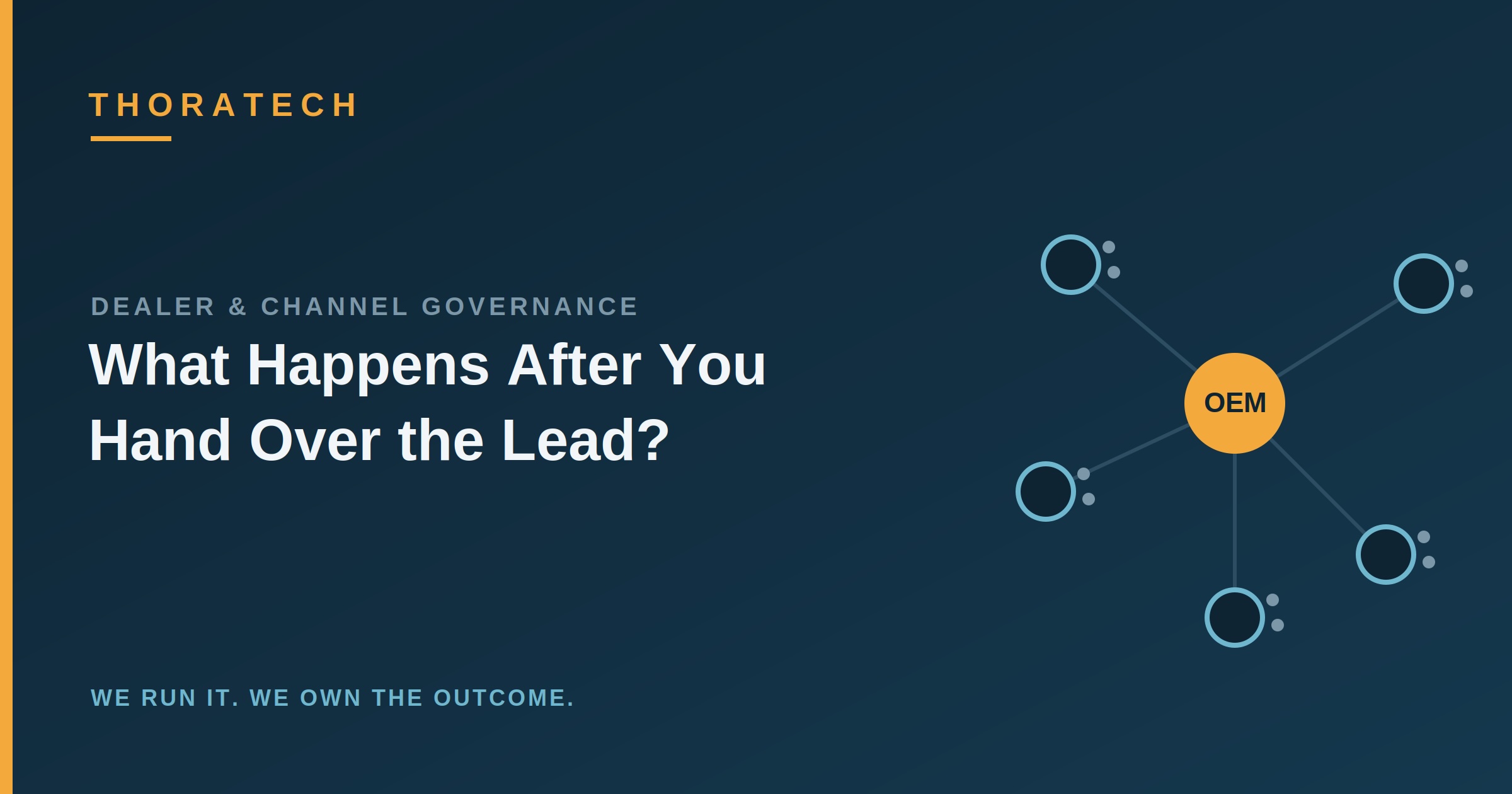
In most industrial businesses, the OEM doesn't actually meet the customer. The dealer does. The dealer makes the sale, installs the machine, answers the breakdown call and decides, every single day, whether your brand feels reliable or frustrating. You build the product; your channel delivers the experience. And yet the moment a lead or a complaint leaves your building and lands with a dealer, most manufacturers go completely blind.
"The dealer will handle it" is one of the most expensive sentences in manufacturing. Sometimes it's true. Often it isn't and you find out months later, when a region's numbers sag or a cluster of complaints reaches head office. By then the damage is done: the lead you generated was never called, the customer who complained was never fixed and the buyer blames you, not the dealer, because your name is on the product.
Where channel visibility collapses
- No SLA on the dealer. You commit response times to your customer in spirit, but nothing binds the dealer to them. A lead can sit for a week and no clock is running.
- No scorecard. You can't rank dealers on what matters, speed, conversion, closure, satisfaction, because you never capture it. Good and poor dealers look identical on your dashboard.
- No independent feedback loop. The dealer reports what they choose to report. You have no direct line to the end customer to verify it.
- Underperformance is invisible until it's terminal. A disengaging dealer doesn't announce it. Enquiries quietly stop converting, service slips and the first hard signal is lost revenue or a lost dealer.
- Onboarding is a handshake, not a process. New dealers are appointed and then left to figure it out, so it takes months before they sell or serve the way you'd want.
Governing the channel without smothering it
Channel governance is not about controlling your dealers. It's about having visibility and a cadence, so you manage by facts instead of by gut and the occasional angry phone call. The operating layer we run over a dealer network does five things:
- 01Governed allocation. Leads and cases are routed to the right dealer by rule, territory, capacity, product line, with a committed response window and full context attached, so nothing lands in a vacuum.
- 02Dealer scorecards. Every dealer is measured on the same handful of metrics that actually predict customer experience: speed to first contact, conversion, closure rate, repeat issues, satisfaction. Ranking becomes objective.
- 03Milestone feedback. Dealers hear how they're doing on a regular cadence, not once a year at a conference. Good performance is reinforced; slippage is named early, while it's still fixable.
- 04Independent customer feedback. A neutral team checks in with the end customer, did the dealer call back, was the issue resolved, are you satisfied, so you're not relying solely on the dealer's self-report.
- 05Disengagement flags. Early warning signs, falling response rates, dropping conversion, rising complaints, surface as flags, not surprises, so you can intervene before you lose the dealer or the region.
Why this protects you, not just polices them
The point isn't to police dealers. It's to protect the brand they carry. A dealer who knows their speed-to-first-call and closure rate is being measured, fairly, against peers, with support attached, behaves differently from one who operates in the dark. And you, sitting at head office, finally get to see your channel as it actually is, not as it's reported to be.
The question to ask yourself
Take your best-performing region and your worst. Do you actually know why they're different or are you guessing? If it's a guess, the gap isn't your dealers' capability. It's your visibility into them and that's something you can fix without adding a single new dealer.
Want this run inside your business? Start with a free process audit.
We will map your current customer operations, surface the gaps and define the outcomes we can own under contractual SLAs.

